List of Requirements to Study in USA
Table of Contents
- Academic Requirements for Studying in USA
- English Language Requirements for USA Universities
- Standardised Test Requirements for USA Admissions
- Documents Required to Study in USA
- Financial Requirements for Studying in USA
- USA Student Visa Requirements
- Undergraduate Admission Requirements in USA
- Masters Admission Requirements in USA
- MBA Admission Requirements in USA
- Requirements to Study in USA Without IELTS
- Scholarships and Financial Aid Requirements for International Students
- How to Meet USA University Admission Requirements: Step-by-Step Process
- Conclusion
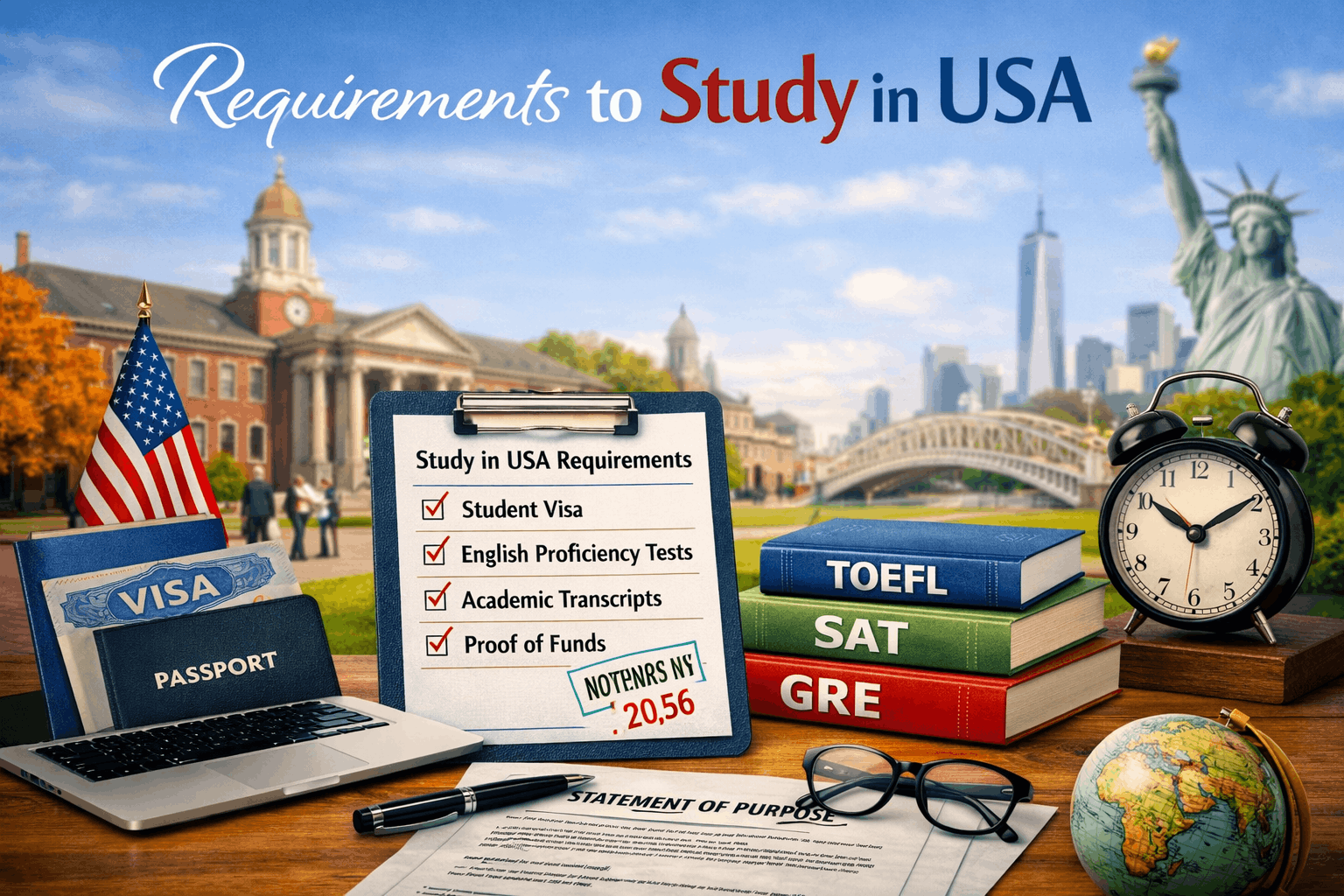
Understanding the Requirements to Study in USA is the first practical step for any international student planning to apply. The process involves clearing several academic, financial, and visa checkpoints before a programme can begin. Applications typically require official transcripts, English proficiency scores through IELTS or TOEFL, standardised test scores such as SAT, ACT, GRE, or GMAT depending on the programme level, and documented proof of financial capacity. Once a university offer is confirmed, securing an F-1 student visa is the next step. Meeting the Requirements to Study in USA early and systematically makes the entire application process considerably more manageable.
Key Highlights: Requirements to Study in USA
Requirement Category | Key Details |
Academic Requirement | 10+2 for undergraduate; bachelor's degree for master's and MBA |
English Language Tests | IELTS, TOEFL iBT, PTE Academic, Duolingo English Test |
Standardised Tests | SAT/ACT (undergraduate); GRE (master's); GMAT/GRE (MBA) |
Minimum GPA | 3.0–3.5 on a 4.0 scale for most programmes |
Financial Proof | Funds covering tuition + living costs for at least one year |
Student Visa | F-1 Student Visa |
SEVIS Fee | USD 350 (INR 29K) |
Visa Application Fee | USD 185 (INR 15.4K) |
Key Documents | I-20, DS-160, transcripts, SOP, LORs, bank statements |
Post-Study Work | OPT (12 months) + STEM OPT (24 months, if applicable) |
Academic Requirements for Studying in USA
Academic eligibility forms the foundation of any US university application. Requirements differ by programme level, with undergraduate and postgraduate applications assessed against different academic benchmarks.
High School Requirements for Undergraduate Programs
For undergraduate admission, USA universities require completion of a recognised secondary school qualification equivalent to the American high school diploma. For Indian students, this means a 10+2 from a recognised board such as CBSE, CISCE, or a state board.
University Tier | Academic Expectations |
Top Universities (Ivy League, MIT, Stanford) | 10+2 with 90%+ aggregate; strong performance in relevant subjects |
Mid-Tier Universities | 10+2 with 75%–85% aggregate or equivalent |
Affordable Public Universities | 10+2 with 60%–75% aggregate; broader subject acceptance |
Most universities also consider the rigour of subjects taken at the secondary level. Strong performance in mathematics, sciences, or humanities directly relevant to the intended major carries weight in the holistic review process.
Bachelor's Degree Requirements for Master's Programs
For master's programmes, a recognised four-year bachelor's degree from an accredited institution is the standard requirement. The subject background expected depends on the programme applied to.
Programme Type | Typical Subject Background Expected |
MS in STEM (Engineering, CS, Data Science) | Bachelor's in engineering, science, mathematics, or a closely related field |
MBA | Bachelor's in any discipline; prior work experience often expected |
MS in Social Sciences / Humanities | Bachelor's in a related discipline; subject prerequisites may apply |
MS in Healthcare / Life Sciences | Bachelor's in science, medicine, or health-related field |
Some universities accept graduates from any discipline for certain programmes, provided prerequisite coursework is completed or quantitative readiness is demonstrated through GMAT or GRE scores.
Academic Transcripts and Mark Sheets
All USA universities require official academic transcripts from every institution attended. These must show subjects studied, grades received, and degrees or qualifications awarded.
Key requirements for transcripts:
Must be issued directly by the institution or a recognised credential evaluation agency
Foreign transcripts must often be evaluated by a NACES-member evaluation service such as WES, ECE, or IERF
Transcripts must be in English or accompanied by a certified English translation
Unofficial transcripts may be accepted for initial review, but official copies are required before enrolment
Minimum GPA Requirements
GPA requirements vary significantly by university tier and programme type. USA universities use a 4.0 GPA scale, so international students must convert their grades accordingly.
University Tier | Minimum GPA Requirement |
Top Universities (Harvard, MIT, Stanford) | 3.7–4.0 (equivalent to 85%–90%+) |
Mid-Tier Universities | 3.0–3.5 (equivalent to 70%–80%) |
Affordable Public Universities | 2.5–3.0 (equivalent to 60%–70%) |
English Language Requirements for USA Universities
All international students whose first language is not English must demonstrate English proficiency through an accepted test. USA universities accept multiple test formats, each with its own scoring system and recognition level.
IELTS Requirements
IELTS Academic is widely accepted across undergraduate and postgraduate programmes at USA universities. It is scored on a band scale from 0 to 9.
University Tier | Minimum IELTS Score |
Top Universities | 7.0–7.5 overall |
Mid-Tier Universities | 6.5 overall |
Affordable Universities | 6.0–6.5 overall |
NOTE: Most universities require a minimum score in each band, typically no band below 6.0, regardless of the overall score.
TOEFL Requirements
TOEFL iBT is the most widely used English proficiency test for USA university admissions. It is scored on a scale of 0 to 120.
University Tier | Minimum TOEFL iBT Score |
Top Universities | 100–110+ |
Mid-Tier Universities | 90–100 |
Affordable Universities | 79–90 |
NOTE: Some universities such as the University of Washington accept TOEFL iBT scores as low as 76 for certain programmes, while others set higher thresholds above 100 for competitive admissions.
PTE Academic Requirements
PTE Academic is a computer-based English test accepted at a growing number of USA universities as a direct alternative to IELTS and TOEFL. It is scored on a scale of 10 to 90.
University Tier | Minimum PTE Score |
Top Universities | 68–75+ |
Mid-Tier Universities | 58–68 |
Affordable Universities | 50–58 |
NOTE: PTE Academic results are typically available within 48 hours of sitting the test, making it a practical option for students with tight application timelines.
Duolingo English Test Requirements
The Duolingo English Test (DET) is an online, on-demand test accepted at a large and growing number of USA universities. It is scored on a scale of 10 to 160.
University Tier | Minimum Duolingo Score |
Top Universities | 120–135+ |
Mid-Tier Universities | 105–120 |
Affordable Universities | 95–105 |
Duolingo is more affordable and accessible than IELTS or TOEFL, but not all universities accept it and it is not approved as a UKVI or equivalent government-recognised test. Students should verify acceptance directly with each programme.
Also check: List of Exams Required to Study in USA in 2026
Standardised Test Requirements for USA Admissions
Standardised test requirements in USA have shifted significantly since 2020. Many universities reinstated test requirements in 2024 and 2025 after a period of test-optional policies adopted during the pandemic.
SAT Requirements for Undergraduate Programs
The SAT, administered by College Board, is the primary standardised test for undergraduate admission in USA. It is scored on a scale of 400 to 1600.
Top universities, including Dartmouth, Yale, Brown, Harvard, Caltech, Stanford, and Johns Hopkins all reinstated test-required policies, and in 2025 and 2026, the University of Pennsylvania, Cornell, Ohio State, and Princeton followed.
University Tier | Competitive SAT Score Range |
Top Universities (Ivy League, MIT, Stanford) | 1480–1600 |
Mid-Tier Universities | 1200–1400 |
Affordable Public Universities | 1000–1200 |
NOTE: For mid-range colleges, SAT scores above 1200 are considered competitive, while top-tier schools typically expect 1400 or above. A perfect 1600 SAT score meets the threshold for elite universities like Harvard.
ACT Requirements
The ACT is accepted as an equal alternative to the SAT at all four-year universities in USA. It is scored on a composite scale of 1 to 36.
University Tier | Competitive ACT Score Range |
Top Universities | 33–36 |
Mid-Tier Universities | 26–32 |
Affordable Public Universities | 20–25 |
NOTE: Since 2007, all four-year colleges and universities in USA that require a standardised test accept either the SAT or ACT. Students do not need to sit both.
GRE Requirements for Master's Programs
The GRE General Test, administered by ETS, is the standard standardised test for master's and doctoral programme admissions in USA. It has three sections: Verbal Reasoning (130–170), Quantitative Reasoning (130–170), and Analytical Writing (0–6).
University Tier | Competitive GRE Score Range |
Top Universities (MIT, Stanford, Berkeley) | 320–340 (combined Verbal + Quantitative) |
Mid-Tier Universities | 305–320 |
Affordable Universities | 295–305 |
According to ETS, scores of 153 in Verbal and 160 in Quantitative are considered competitive for business programmes, while 161 in Quantitative and 151 in Verbal are benchmarks for engineering programmes. GRE scores remain valid for five years.
GMAT Requirements for MBA Programs
The GMAT, administered by GMAC, is the primary standardised test for MBA admissions. It is scored on a composite scale of 205 to 805.
University Tier | Competitive GMAT Score Range |
Top MBA Programs (Harvard, Wharton, Kellogg) | 720–780+ |
Mid-Tier MBA Programs | 620–700 |
Affordable MBA Programs | 550–620 |
Documents Required to Study in USA
A complete and well-organised application requires specific documents at both the university application and visa stages. Missing or incomplete documents are one of the most common reasons for application delays and visa rejections.
Academic Transcripts
Official transcripts from all secondary and post-secondary institutions attended are required. Foreign transcripts may need evaluation by a NACES-approved service for US equivalency.
Detail | Requirement |
What Is Required | Official transcripts from all secondary and post-secondary institutions attended |
Content Needed | Grades, subjects studied, and qualifications awarded |
Foreign Transcript Evaluation | May require evaluation by a NACES-approved service for US equivalency |
Initial Application | Most universities accept unofficial transcripts for initial review |
Enrolment Confirmation | Official transcripts required before enrolment is confirmed |
Statement of Purpose
The SOP is one of the most important documents in a US university application, particularly for master's and PhD programmes. A well-written SOP is specific, structured, and free of generic language. Admissions committees read hundreds of these documents, and clarity of intent makes the strongest impression.
SOP Component | What to Cover |
Academic Background | Prior qualifications, relevant subjects, and academic achievements |
Professional Experience | Work history and how it connects to the chosen programme |
Programme and University Fit | Specific reasons for choosing this programme and institution |
Career Goals | Short-term and long-term professional objectives after graduation |
Candidate Strength | Why you are a strong fit for this specific cohort |
Letters of Recommendation
Most US universities require two to three letters of recommendation, submitted directly by the referee through the university's online portal. Strong LORs are specific, evidence-based, and written by people who have directly observed academic or professional performance.
Programme Level | Recommended Sources |
Undergraduate | Teachers from 10+2 level, school counsellors |
Master's | University professors, research supervisors, professional managers |
MBA | Direct line managers, senior colleagues, mentors with professional authority |
Resume or CV
A well-structured resume or CV is required for most master's and MBA applications. Most university portals specify a maximum of one to two pages. Brevity and relevance matter more than length.
Resume Section | What to Include |
Educational Background | Institutions attended, dates, and qualifications earned |
Professional Experience | Job titles, key responsibilities, and measurable achievements |
Research and Projects | Research experience, publications, and academic projects |
Leadership and Activities | Extracurricular roles, certifications, and community involvement |
Technical Skills | Relevant tools, software, and technical competencies |
Passport and Identity Documents
A valid passport is required for both university applications and the F-1 visa process. Students should ensure their passports are current well before submitting applications, as renewal can take several weeks.
Requirement | Detail |
Passport Validity | Must remain valid for at least 6 months beyond the intended period of stay in USA |
Purpose | Required for university application and F-1 visa process |
Renewal Timeline | Allow several weeks for passport renewal if needed before application deadlines |
Copies Required | Both physical and digital copies should be kept throughout the application process |
Financial Requirements for Studying in USA
USA is one of the most expensive study destinations globally, and universities require firm evidence that students can cover their costs before issuing an I-20 and processing the visa application.
Proof of Funds
Financial proof must cover at least the first year of study, including tuition and living expenses, as stated on the I-20 form. Accepted financial documents include:
Bank statements showing sufficient funds for a minimum of six months prior to the application date
Fixed deposit certificates
Education loan sanction letter from a recognised bank
Scholarship award letter (if applicable)
Sponsor's financial affidavit with supporting bank statements
The funds must be readily accessible, not tied up in property, investments, or assets that cannot be liquidated quickly.
Tuition Fee Estimates:
University Tier | Approximate Annual Tuition Fees (International Students) |
Top Universities (Harvard, MIT, Stanford) | USD 55,000–80,000 (INR 45.6L–66.4L) |
Mid-Tier Universities | USD 30,000–55,000 (INR 24.9L–45.6L) |
Affordable Public Universities | USD 15,000–30,000 (INR 12.4L–24.9L) |
Must check: Cost of Living in USA in 2026
USA Student Visa Requirements
International students enrolled full-time at a SEVP-approved US university must apply for an F-1 Student Visa. The process begins with receiving the I-20 from the university and ends at the visa interview at a US embassy or consulate. All steps must be completed in the correct sequence before travelling.
Visa Requirement | Details |
Student Visa Type | F-1 Student Visa |
Form I-20 | Issued by SEVP-approved university after admission confirmation |
SEVIS Fee | USD 350 (INR 29K) |
DS-160 Application | Completed online via CEAC portal; mandatory for all F-1 applicants |
Visa Application Fee | USD 185 (INR 15.4K) |
Visa Interview | Conducted at nearest US embassy or consulate |
Financial Proof | Funds covering first-year tuition and living costs as stated on I-20 |
Post-Study Work | OPT 12 months + STEM OPT 24 months (if applicable) |
Must check: Settle in USA
Undergraduate Admission Requirements in USA
Students planning to pursue a Bachelors in USA must meet academic eligibility requirements, submit secondary school transcripts, and, where applicable, provide SAT or ACT scores. Applications are generally submitted through the Common App or directly through university admission portals.
Requirement | Details |
Academic Qualification | 10+2 from a recognised board (CBSE, CISCE, state board or equivalent) |
Minimum Grades | 75%–90%+ depending on university tier |
SAT Score | 1000–1600 depending on university tier |
ACT Score | 20–36 depending on university tier |
English Proficiency | IELTS 6.0–7.5 / TOEFL 79–110 / PTE 50–75 / Duolingo 95–135 |
Letters of Recommendation | 2–3 from teachers or school counsellors |
Personal Essay | Required through Common App or university portal |
Application Deadline | Early Decision: October–November; Regular Decision: December–January |
Masters Admission Requirements in USA
A Masters in USA requires a recognised bachelor's degree, GRE scores for most research-intensive programmes, and strong academic preparation in relevant subject areas. Applications are submitted directly through university portals, with most Fall intake deadlines running from November through March.
Requirement | Details |
Academic Qualification | Four-year bachelor's degree from an accredited institution |
Minimum GPA | 3.0–3.7 on a 4.0 scale depending on university tier |
GRE Score | 295–340 combined Verbal + Quantitative depending on programme |
English Proficiency | IELTS 6.5–7.5 / TOEFL 90–110 / PTE 58–75 / Duolingo 105–135 |
Prerequisites | Programme-specific undergraduate courses (varies by field) |
Letters of Recommendation | 2–3 from university professors or professional supervisors |
Statement of Purpose | Required at all universities |
Work Experience | Not mandatory; strengthens application at competitive programmes |
MBA Admission Requirements in USA
An MBA in USA requires a bachelor's degree, GMAT or GRE scores, and typically two to five years of professional work experience. Top business schools assess applicants holistically across academics, leadership, career clarity, and essay quality. Applications are submitted through individual business school portals across multiple rounds.
Requirement | Details |
Academic Qualification | Four-year bachelor's degree from a recognised institution |
Minimum GPA | 3.0–3.5+ depending on programme tier |
GMAT Score | 550–780+ depending on university tier |
GRE Score | 295–340 combined; accepted at 92% of business schools |
English Proficiency | IELTS 6.5–7.5 / TOEFL 90–110+ |
Work Experience | 2–5 years preferred; 3+ years expected at top programmes |
Application Essays | 1–3 essays or short-answer questions; varies by school |
Letters of Recommendation | 2–3 professional references from direct supervisors or mentors |
Requirements to Study in USA Without IELTS
IELTS is not the only accepted proof of English proficiency for US university admissions. Several officially recognised alternatives are accepted at undergraduate and postgraduate level. The right option depends on the university's published policy and the programme applied to.
Alternative | Accepted For Admission | Notes |
TOEFL iBT | Yes, widely accepted | Most common IELTS alternative; accepted at virtually all US universities |
PTE Academic | Yes, widely accepted | Computer-based; results within 48 hours |
Duolingo English Test | Yes, at select universities | Online and affordable; not accepted everywhere |
Medium of Instruction (MOI) Certificate | Yes, at select universities | Prior degree must be fully English-medium; typically within 5–7 years |
Cambridge C1 / C2 | Yes, at select universities | Accepted at a growing number of graduate programmes |
English Waiver | Yes, where criteria are met | Available for citizens of English-speaking countries or prior English-medium graduates |
Scholarships and Financial Aid Requirements for International Students
Funding a US degree as an international student requires knowing where to look and what each award demands. While federal financial aid is restricted to US citizens, a strong range of merit-based, need-based, and university-specific options remains available to international applicants across undergraduate, master's, and MBA programmes.
Merit-Based Scholarships
Merit scholarships are awarded based on academic performance, test scores, leadership record, and overall application strength. Most are reviewed automatically at the point of admission, with no separate application required.
Scholarship | Eligibility | Coverage |
Fulbright Foreign Student Program | Bachelor's degree; strong academic record; applied through the Fulbright Commission or US Embassy in the home country | Full or partial tuition, monthly stipend, airfare, health insurance |
Knight-Hennessy Scholars (Stanford) | Any graduate programme at Stanford; demonstrated leadership and civic engagement | Full tuition, stipend, academic and travel allowance |
University Merit Scholarships | Varies by university; based on GPA, test scores, and academic profile; reviewed at admission | Partial to full tuition reduction; no separate application at most institutions |
Need-Based Financial Aid
Need-based aid for international students is limited at most US public universities, as federal programmes are restricted to domestic students. However, a number of elite private universities explicitly commit to meeting full demonstrated financial need for admitted international applicants.
University | Need-Based Aid Policy |
Harvard University | Meets 100% of demonstrated financial need for all admitted students, including international |
MIT | Meets full demonstrated need; no loans in aid packages |
Princeton University | Meets 100% of demonstrated need; grants only, no loans |
Yale University | Meets full demonstrated need for all admitted students |
University-Specific Funding Opportunities
Most universities offer departmental fellowships, graduate assistantships, teaching assistantships, and research assistantships that significantly reduce costs for postgraduate students. These are awarded based on academic merit, research potential, and departmental availability.
Funding Type | Who It Applies To | Typical Coverage |
Graduate Assistantship (GA) | Master's and PhD students | Partial to full tuition + monthly stipend USD 800–2,000 (INR 66.4K–1.66L) |
Teaching Assistantship (TA) | PhD and select master's students | Tuition waiver + monthly stipend |
Research Assistantship (RA) | PhD and research master's students | Tuition waiver + monthly stipend |
Departmental Fellowship | Competitive applicants across all fields | Partial to full tuition; amount varies by programme |
Also check: Fully Funded Masters Scholarships in USA for Indian Students in 2026
How to Meet USA University Admission Requirements: Step-by-Step Process
Meeting the requirements to study in USA involves a sequence of clearly defined steps. Following them in order, and starting early, is what separates successful applicants from those who miss deadlines or submit incomplete applications.
Step 1: Research Universities and Courses: Identify programmes that align with your academic background, career goals, and budget using QS World University Rankings, US News Rankings, and official university websites. Check relevant accreditation, such as AACSB, ABET, CAHME, or CAPTE, depending on your field of study.
Step 2: Check Eligibility Criteria: Review GPA expectations, prerequisite courses, test score requirements, English proficiency standards, and work experience criteria on each programme's official admissions page. Applying to programmes where you clearly meet the threshold is always more effective than overreaching across too many competitive options.
Step 3: Prepare Test Scores and Documents: Begin test preparation at least six to twelve months before the application deadline, as IELTS, TOEFL, GRE, GMAT, SAT, and ACT all require dedicated preparation time. Gather transcripts, arrange credential evaluation if required, request LORs with sufficient notice, and draft your SOP well ahead of deadlines.
Step 4: Submit Applications: Apply through each university's official admissions portal, keeping close track of fees and deadlines which vary by institution and intake round. Applying in the earliest available round consistently improves both admission outcomes and scholarship consideration across all programme levels.
Step 5: Apply for a Student Visa: Once you have accepted an offer and received your I-20, begin the F-1 visa process without delay by paying the SEVIS fee, completing the DS-160, and scheduling your embassy interview. Wait times at US embassies vary significantly by country and season, so booking your appointment as early as possible is critical.
Conclusion
Meeting the requirements to study in USA takes planning, preparation, and a clear understanding of what each stage demands. From academic qualifications and English proficiency tests to financial proof and the F-1 visa process, every element plays a role in determining your admission outcome. Students who start early, research programme-specific criteria carefully, and build strong application documents consistently achieve better results. Whether you are applying for an undergraduate degree, a master's programme, or an MBA, understanding the full set of requirements to study in USA gives you a measurable advantage before the process even begins.
Need help with your study abroad plan? Book a free counseling session with our experts today.